
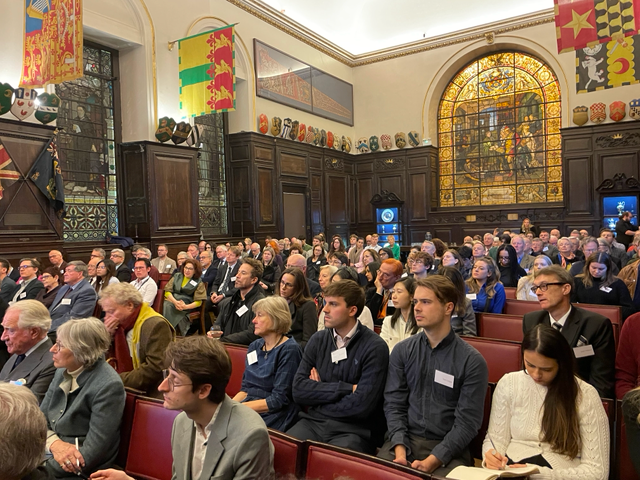
Some 200 filled the seats to hear this week’s London Press Club debate on “AI: Saviour or assassin for the media and democracy”. The top line-up panel at the annual debate held in association with the Stationers & Newspaper Makers livery tackled every aspect from freedom of the Press to financial viability of news brands.
Report by Jonathan Grun, former Editor in Chief of PA Media and former President of the Society of Editors
BBC news journalist and Press Club Director Samantha Simmonds laughed when she saw herself appearing in a deep fake video alongside the prime minister promoting a get-rich-quick investment.
“I just thought it was funny until my mother-in-law called me, asking me if she could invest in this great scheme, at which point I became a little bit alarmed,” Samantha told the audience at Stationers’ Hall.
“This is real-world issue that we are all now grappling with.”
Samantha chaired the annual London Press Club/Stationers’ Company debate, which posed the question: “Is Artificial Intelligence the saviour or assassin for journalism and democracy?”
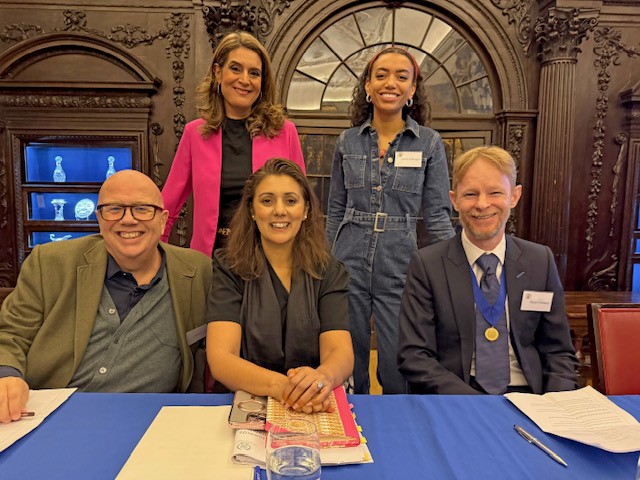
The positive potential of AI was stressed by all the speakers:
:: Nusrat Ghani MP, Principal Deputy Speaker of the House of Commons, said she wished to ensure that our Parliament became the most AI efficient in the world.
:: Digital executive, Anne-Marie Tomchak stressed that AI could be the most transformative development since the introduction of electricity.
:: Rupert Knowles, CEO of NXT Media Consulting, said AI could do a lot of the dull tasks in journalism, freeing up journalists to be creative.
: Doug Wills, who chairs the London Press Club, said the opportunities of technology should be embraced.
But amidst the benefits there were warnings of threats posed by AI, including the risk to the media’s business model and the threat to journalists’ jobs.
Award-winning columnist Chris Blackhurst said he was inspired to be a journalist by All the President’s Men, the story of how legendary journalists Bob Woodward and Carl Bernstein brought down President Richard Nixon.
“Those journalists were human beings, they weren’t bots, they weren’t AI,” Chris said.
Chris pointed out that the tech companies developing AI do not want to pay for content and he supported the News Media Association’s Make it Fair campaign, in which the UK’s creative industries warn how their content is at risk of being given away for free to AI firms if government weakens copyright law. He said: “We have a big fight on our hands.”
Emma Loffhagen, commissioning editor on the culture and lifestyle desks at the Guardian Saturday magazine, said AI brought benefits but also posed a threat to the business model of journalism as aggregated information led to loss of revenue.
And Emma stressed the unique human factor that real journalists bring to reporting. “AI can’t interview a grieving mother, AI can’t win the trust of a whistleblower, AI can’t do the most fundamental things that we do as journalists.”
Click on the link below for a video compilation of images from the debate.
The Standard reported on the Debate:
A senior MP warned this week that no election in Europe can be guaranteed as “free and safe” due to AI-enabled foreign interference.
Nusrat Ghani, a deputy speaker of the House of Commons, told the London Press Club this week that artificial intelligence (AI) must be “harnessed” as a force for good “before it becomes an assassin of democracy”.
Speaking as part of a panel discussion in London’s Stationers’ Hall on Monday night, the Conservative MP for Sussex Weald suggested that, if used in a responsible way, the technology could be used to bring “Parliament closer to the public” and prevent voters drifting towards “extreme” political movements.
For complete article, CLICK HERE

